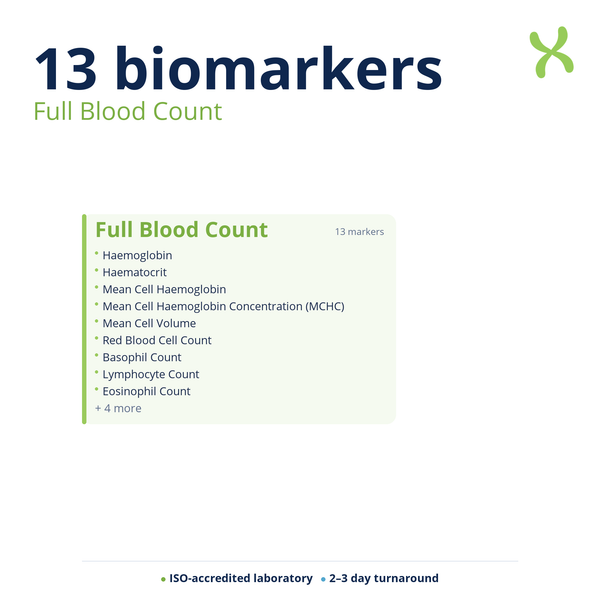
Haemoglobin
The oxygen-carrying part of your red blood cells.
Why it matters
Low levels are linked to feeling tired or short of breath.


Price is for one test. No subscription.
The check-in. One test, typically repeated every 3 to 6 months while you're on GLP-1.
Weight Loss Monitoring is the 53-marker companion panel to Weight Loss Commencement. Run it at 3 or 6 month intervals during your weight loss treatment to see how your body is responding — and to spot anything that needs attention before it becomes an issue.
What this panel tracks
Sample
4 blood tubes plus 1 urine sample (for the microalbumin check).
Fasting required ★ — please fast for 12 hours before your draw. Critical for accurate insulin, glucose and lipid readings.
How often people retest
Most people repeat this test every 3 or 6 months while on a GLP-1 programme. The price is for one test, and each one is booked and paid for separately. Compare each result against your initial Weight Loss Commencement baseline to track real progress.
Analysed in our ISO-accredited UK laboratory.
*Sample requirements: x4 Blood Sample, x1 Urine Sample
Sample requirements
Collected at either our Chxhealth clinic in Lanchester (book your appointment during checkout) or at one of our 50+ UK partnered clinics (you'll receive a separate booking email after checkout). Phlebotomy fee included in the price.
The oxygen-carrying part of your red blood cells.
Low levels are linked to feeling tired or short of breath.
The proportion of your blood made up of red cells.
Gives a quick snapshot of how oxygen-rich your blood is.
The average amount of haemoglobin in each red blood cell.
Helps show whether your red cells are well-stocked with oxygen-carrying protein.
How concentrated the haemoglobin is in your red blood cells.
Another angle on red blood cell quality, useful when looking at iron status.
The average size of your red blood cells.
Cell size can hint at iron, B12 or folate levels.
The number of red cells in your blood.
Red cells carry oxygen — too few or too many can both be a sign something's off.
A type of white blood cell.
Linked to allergic responses and how your body deals with irritants.
Immune-system white blood cells.
Shows how your body is responding to infections or viruses.
A white blood cell linked to allergies and parasites.
Higher levels can be a sign of allergies or other immune activity.
A clean-up white blood cell.
Gives insight into longer-running immune activity.
Your front-line infection-fighting white blood cells.
Often higher when your body is fighting something off.
The total count of immune cells in your blood.
A general marker of how active your immune system is.
Tiny cells that help your blood clot.
Low or high counts can be a sign your clotting balance is off.
The total amount of cholesterol in your blood.
A long-standing marker for heart and circulation health.
The 'less helpful' type of cholesterol.
Higher levels are linked to a greater chance of furred-up arteries over time.
The 'helpful' type of cholesterol.
Higher levels are generally linked to better heart health.
Total cholesterol compared with HDL.
A simple ratio that gives a clearer picture than total cholesterol alone.
Fats circulating in your blood.
Linked to diet, weight and heart health — often respond well to lifestyle tweaks.
The main protein in LDL ('less helpful') cholesterol.
Gives a more direct read on artery-clogging particles than LDL alone.
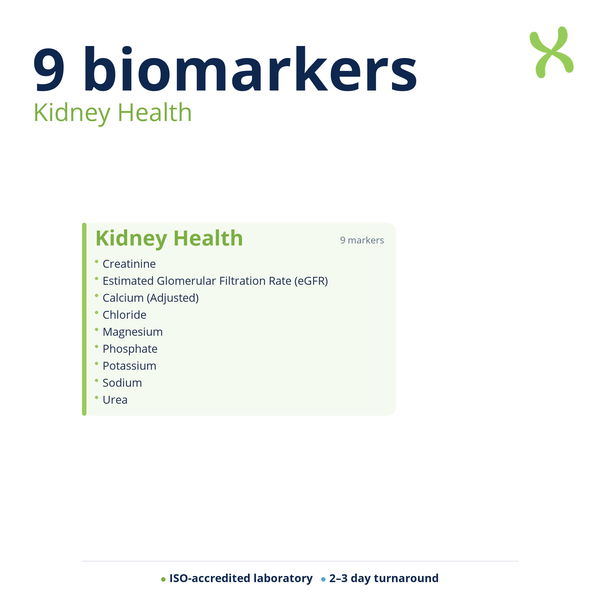
A waste product cleared by your kidneys.
A core marker for how well your kidneys are filtering.
An estimate of how well your kidneys are filtering.
A simple summary score for kidney function.
A mineral important for bones, muscles and nerves.
Useful for understanding bone health and overall nutrition.
An electrolyte that keeps your body's fluids balanced.
Useful alongside sodium and potassium for hydration and kidney insight.
A mineral involved in energy, sleep and muscle function.
Low levels are linked to fatigue, cramps and poor sleep.
A mineral that works with calcium for bones and energy.
Levels can shift with diet, kidney function or bone activity.
An electrolyte your heart and muscles rely on.
Both low and high levels can affect how you feel.
Your main fluid-balance electrolyte.
Linked to hydration, blood pressure and kidney health.
A waste product from breaking down protein.
Another check on kidney filtering and hydration.
A urine check comparing albumin to creatinine.
An early indicator of kidney strain — picks things up before standard kidney markers shift.
A liver health marker.
Higher levels can be a sign your liver is under stress, often linked to diet, alcohol, or fatty liver.
A marker linked to both liver and bone health.
Levels can shift when the liver is under strain or when bones are remodelling more than usual.
Another liver health marker.
Read alongside ALT, it gives extra insight into how your liver and muscles are coping.
A liver marker (often called GGT).
Often raised by alcohol or fatty liver — a useful check-in on lifestyle impact.
A waste product the liver clears from your blood.
Higher levels can be a sign your liver isn't clearing things as efficiently as usual.
The main protein in your blood, made by the liver.
Gives insight into liver function and overall nutrition.
Your average blood sugar over the last few months.
Useful for understanding how your body handles sugar over time.
Your blood sugar level at the moment of testing.
A snapshot of how your body is handling sugar right now.
The hormone that helps move sugar from blood into cells.
Gives insight into how hard your body is working to keep sugar in check.
A calculated score from your fasting insulin and glucose.
Picks up insulin resistance years before it shows in HbA1c.
The hormone that tells your thyroid how hard to work.
A first-line marker for thyroid balance.
The active form of one of your main thyroid hormones (T4).
Adds detail beyond TSH for a fuller thyroid picture.
The main form of oestrogen.
Linked to mood, cycle, skin and bone health.
A hormone involved in fertility and the menstrual cycle.
Gives insight into reproductive hormones for both men and women.
A hormone involved in ovulation and testosterone production.
Helps complete the reproductive-hormone picture.
A hormone made by the pituitary gland.
Higher levels can be linked to cycle changes or fertility insight.
Your main androgen hormone.
Linked to energy, mood, libido and muscle for both men and women.
Sex hormone binding globulin — a protein that carries hormones in your blood.
Affects how much testosterone and oestrogen are actually active in your body.
A calculated estimate of active testosterone.
A simple summary of androgen activity.
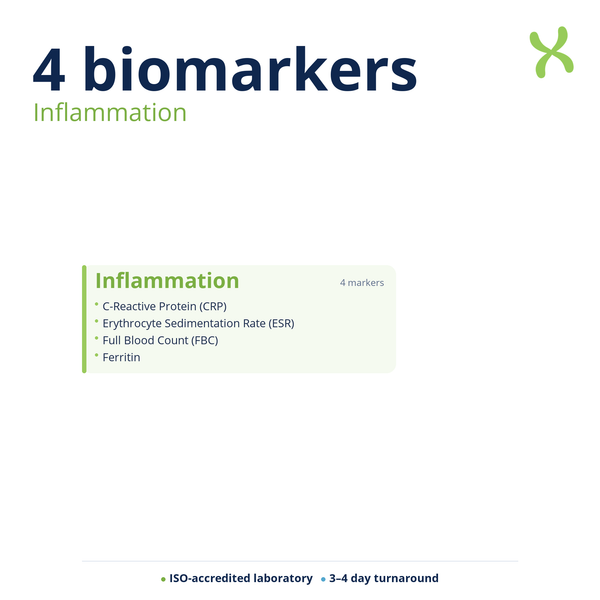
A sensitive marker of low-level inflammation.
Low-grade inflammation is linked to heart and metabolic health.
A pancreas enzyme that breaks down fats.
A more pancreas-specific check than amylase.
An enzyme made by the pancreas.
Levels can shift if the pancreas is under stress.
Your body's iron stores.
Low levels can leave you feeling tired; very high levels can be a sign of inflammation or iron overload.
A vitamin you make from sunlight and get from food.
Linked to bone strength, immune function and mood. Many people in the UK run low.
This panel reports biomarker data. It does not diagnose any condition. Your results should be reviewed alongside the advice of your GP or another qualified healthcare professional.
Choose your test, complete your details and book your appointment (either through an email sent after an order with a UK partnered clinic or on our site for our own clinic).
Visit our Chxhealth Clinic in County Durham or head to one of our 50+ partnered clinics all over the UK.
ISO accredited process through our lab partners. Your sample is analysed using independently certified methods and is double checked for accuracy.
Easy-to-read results sent from us to your inbox.
Symptoms tell you something is wrong. Tests tell you what. This panel measures the biomarkers that connect to how you actually feel — so you can act with evidence, not guesswork.
Weight Loss Monitoring results are typically delivered within 3 working days of the laboratory receiving your sample. You receive a plain English PDF report.
Weight Loss Monitoring requires a venous blood draw at a Chxhealth or partner clinic. The phlebotomy fee is included in the price. Choose our Lanchester clinic or one of our 50+ UK partner and pop-up clinics when you book.
Typical cadence is every 3 to 6 months, or more frequently around dose changes if you are on weight-loss medication. The panel is designed to be retested over time alongside Weight Loss Commencement as your baseline.
It covers the biomarkers most relevant to ongoing weight management: lipids, glucose, insulin, liver enzymes, thyroid, and nutritional markers that can shift during sustained weight loss.
Yes. The panel covers the markers most often monitored during GLP-1 treatment, so you can track progress alongside the clinician managing your medication. Chxhealth is a biomarker and genetic data provider. We do not diagnose, treat or prescribe. For medical advice, please speak to a qualified healthcare professional.
Lab-validated, expert-reviewed, in your inbox in days.