Haemoglobin
The oxygen-carrying part of your red blood cells.
Why it matters
Low levels are linked to feeling tired or short of breath.


A streamlined screening tool that simultaneously assesses lipid metabolism and glycaemic status to evaluate diabetes and cardiovascular risk profiles. This integrated panel measures key biomarkers—total cholesterol, HDL, LDL, triglycerides, and HbA1c—providing clinicians with actionable data for early intervention and risk stratification. Essential for preventative health assessments and chronic disease management in primary care settings.
Sample requirements
Collected at either our Chxhealth clinic in Lanchester (book your appointment during checkout) or at one of our 50+ UK partnered clinics (you'll receive a separate booking email after checkout). Phlebotomy fee included in the price.
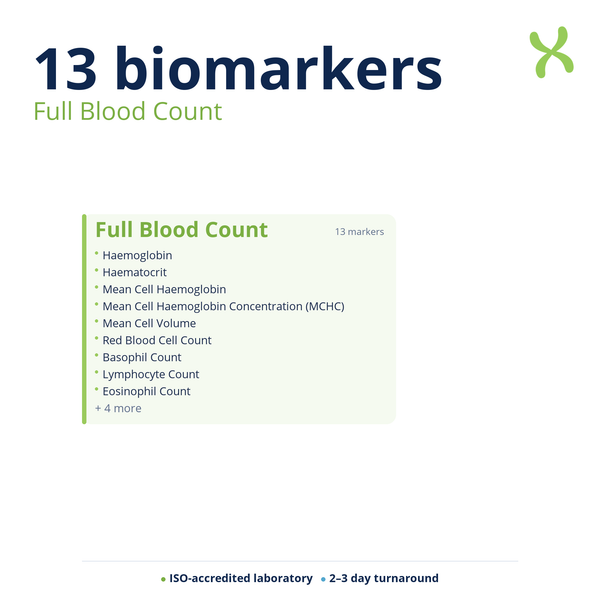
The oxygen-carrying part of your red blood cells.
Low levels are linked to feeling tired or short of breath.
The proportion of your blood made up of red cells.
Gives a quick snapshot of how oxygen-rich your blood is.
The average amount of haemoglobin in each red blood cell.
Helps show whether your red cells are well-stocked with oxygen-carrying protein.
How concentrated the haemoglobin is in your red blood cells.
Another angle on red blood cell quality, useful when looking at iron status.
The average size of your red blood cells.
Cell size can hint at iron, B12 or folate levels.
The number of red cells in your blood.
Red cells carry oxygen — too few or too many can both be a sign something's off.
A type of white blood cell.
Linked to allergic responses and how your body deals with irritants.
Immune-system white blood cells.
Shows how your body is responding to infections or viruses.
A white blood cell linked to allergies and parasites.
Higher levels can be a sign of allergies or other immune activity.
A clean-up white blood cell.
Gives insight into longer-running immune activity.
Your front-line infection-fighting white blood cells.
Often higher when your body is fighting something off.
The total count of immune cells in your blood.
A general marker of how active your immune system is.
Tiny cells that help your blood clot.
Low or high counts can be a sign your clotting balance is off.
The total amount of cholesterol in your blood.
A long-standing marker for heart and circulation health.
The 'less helpful' type of cholesterol.
Higher levels are linked to a greater chance of furred-up arteries over time.
The 'helpful' type of cholesterol.
Higher levels are generally linked to better heart health.
Total cholesterol compared with HDL.
A simple ratio that gives a clearer picture than total cholesterol alone.
Fats circulating in your blood.
Linked to diet, weight and heart health — often respond well to lifestyle tweaks.
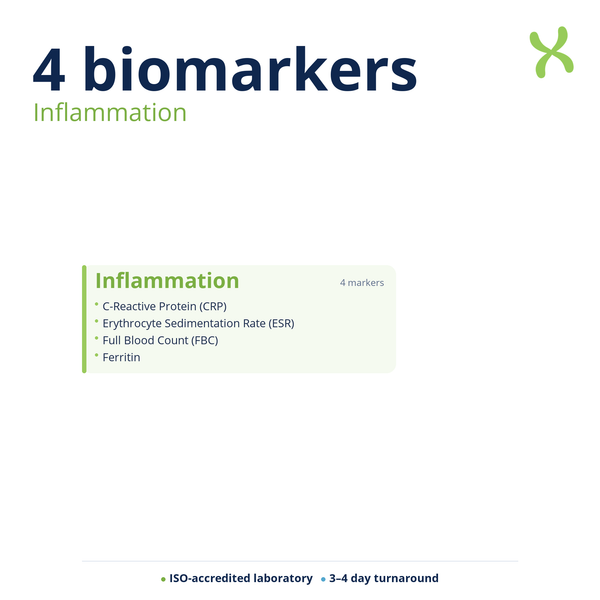
A sensitive marker of low-level inflammation.
Low-grade inflammation is linked to heart and metabolic health.
Your average blood sugar over the last few months.
Useful for understanding how your body handles sugar over time.
This panel reports biomarker data. It does not diagnose any condition. Your results should be reviewed alongside the advice of your GP or another qualified healthcare professional.
Choose your test, complete your details and book your appointment (either through an email sent after an order with a UK partnered clinic or on our site for our own clinic).
Visit our Chxhealth Clinic in County Durham or head to one of our 50+ partnered clinics all over the UK.
ISO accredited process through our lab partners. Your sample is analysed using independently certified methods and is double checked for accuracy.
Easy-to-read results sent from us to your inbox.
Symptoms tell you something is wrong. Tests tell you what. This panel measures the biomarkers that connect to how you actually feel — so you can act with evidence, not guesswork.
Results are typically delivered within 2 working days of the laboratory receiving your sample. You receive a plain English PDF report covering total cholesterol, HDL, LDL, triglycerides, and HbA1c.
This panel requires a venous blood draw at a Chxhealth or partner clinic. The phlebotomy fee is included in the price. Choose our Lanchester clinic or one of our 50+ UK partner and pop-up clinics when you book.
Yes. Triglycerides and the full lipid profile are most accurate after a 10 to 12 hour fast, water only. HbA1c does not need fasting but the rest of the panel does.
The combination is ideal for tracking overall cardiometabolic risk in one panel. It suits adults with a family history of heart disease or diabetes, anyone making dietary or weight changes, and people who want to monitor both cholesterol and longer-term blood sugar control in one visit.
If you are tracking lifestyle changes or medication response, every 3 to 6 months. For general monitoring, annually is reasonable.
Lab-validated, expert-reviewed, in your inbox in days.